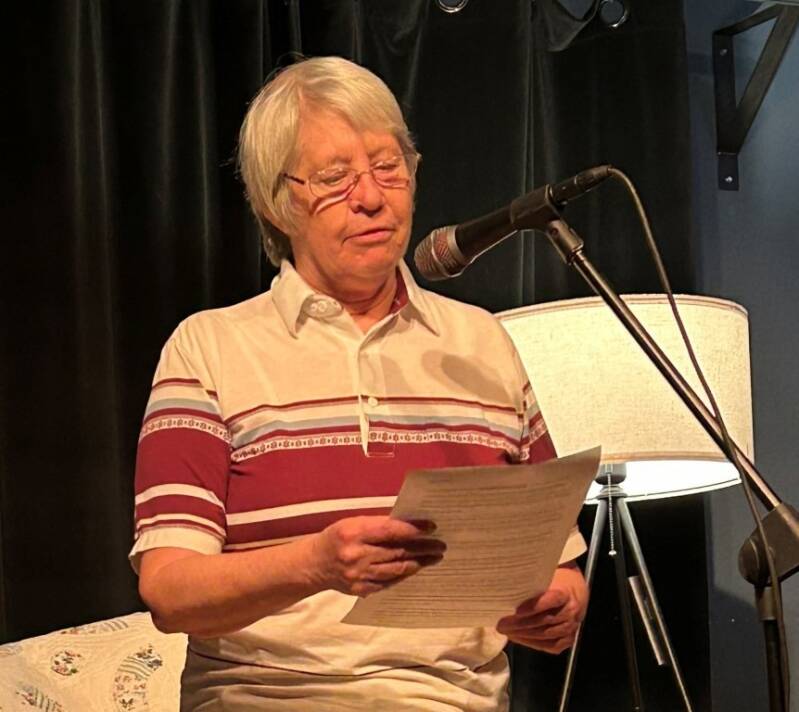
After the Persimmon Tree literary journal picked up my short contribution to their summer forum, I reworked the piece into a longer essay and presented it last Thursday on the Cherokee County Arts Council stage in Murphy, NC. The event, Poetry, Prose, and Pie, is a series sponsored by Common Ground, a grassroots organization dedicated to peace, justice, and community building in Western North Carolina. Their efforts emphasize education, advocacy, and bridging divides within the local mountain communities. This is the third PPP event I’ve participated in, where local authors share their work around a theme. This time, the theme was “Found,” and here is my essay:
FOUND. I generally use the term as the past tense of “to find”—to discover or locate something: “I FOUND a nickel on the sidewalk!” or “Check the lost-and- FOUND box to see if your missing sweater is there.”
The word can also appear within larger words, such as an exclamation (“ConFOUND it!”), an expression of puzzlement (“The mystery conFOUNDed me”), a description of making speechless with astonishment (“Her ability to accomplish seemingly impossible tasks left me dumbFOUNDed”), or a reference to something deep, intense, and far-reaching (proFOUND).
But the verb, to FOUND, has another, more insightful definition: It means to establish a solid base upon which something lasting may be built. My house rests on a FOUNDation, so I expect it to be around a while.
The concept of FOUNDing goes well beyond stone and bricks.
Two hundred and fifty years ago, our nation’s FOUNDers wrote the Declaration of Independence, which established the United States as a sovereign nation, and laid out the FOUNDational ideals under which they expected the new country to govern itself. It enumerated core principles that outline the rights that serve as the bedrock of American democracy. It goes on to list over two dozen specific grievances against King George III, a description of how the colonists had petitioned for relief (only to be answered by repeated injury), and a declaration of severance from the British Crown. Fifty-six men signed the document. A monumental struggle ensued before the Americans prevailed. Things got better.
Just over a century later, Jane Addams and her colleague Ellen Gates Starr FOUNDed Hull House in a poor immigrant neighborhood of Chicago. They offered child care, job training, adult education, cultural programs, and much more. According to the Jane Addams Hull House Association, Hull House became a national model that helped inspire reforms in labor laws, child welfare, sanitation, and education. Addams also co‑FOUNDed the American Civil Liberties Union in 1920. In 1931, she received the Nobel Peace Prize for her lifelong commitment to humanitarian work. Jane Addams reshaped American social policy, pioneered the profession of social work, and demonstrated that civic engagement and compassion can be powerful tools for structural change. Things got better.
Another century has passed. The United States today seems chaotic, less solid than it felt a generation ago. Perhaps it’s time to revisit the idea of FOUND. Time and again, throughout our nation’s history, Americans have proved themselves up to the challenge of course correction.
Today, we’ve FOUND ourselves at a new crossroads. Maybe we need to refresh our collective memory of the ideals our FOUNDers penned in 1776 and think about where we got off track.
It looks as if “We the people” are finally realizing that we have been had. We’ve moved from oblivious to apathetic to passively discontented to concerned to alarmed and angry. Some of us have wondered just how far our citizens can be pushed before they push back. I think we have reached the brink.
Pushing back, without a vision of where we want to go, might be an invitation to anarchy. Instead, let’s look at this 250th anniversary as an opportunity to reframe our way forward in the context of lessons learned over the past two and a half centuries.
“Freedom from,” “freedom to,” and “responsibility for” must walk hand-in-hand. Now is the time to revisit our national objectives, examine what has worked and what hasn’t, and lay out a new path.
Let’s declare our independence from chaos, corruption, and misinformation. Let’s reaffirm our freedoms of religion, speech, press, assembly, and petition. And let’s remember that it is our duty to stay informed, understand, and participate in our own governance.
We can fix this.
Photo by Catherine Yost
#declarationofindependence #WeCanFixThis #commonground
Add comment
Comments